Minding The Gap
Minding The Gap
Minding The Gap
Minding The Gap
Minding The Gap
Minding The Gap
Minding The Gap
Minding The Gap
Understanding and Personalising Self-Management for Stress
Understanding and Personalising Self-Management for Stress
Understanding and Personalising Self-Management for Stress
A personalised(+gamified) self-stress management tool that helps identify stress-relieving activities best suited for the user.
Intended to provide temporary stress relief and equip with self-management skills, especially in situations where professional help is not immediately available (designed to be implemented in schools)
Developed with + validated by mental health professionals.
A personalised(+gamified) self-stress management tool that helps identify stress-relieving activities best suited for the user.
Intended to provide temporary stress relief and equip with self-management skills, especially in situations where professional help is not immediately available (designed to be implemented in schools)
Developed with + validated by mental health professionals.
A personalised(+gamified) self-stress management tool that helps identify stress-relieving activities best suited for the user.
Intended to provide temporary stress relief and equip with self-management skills, especially in situations where professional help is not immediately available (designed to be implemented in schools)
Developed with + validated by mental health professionals.
Product
Digital Tool(Game)
Sector
Education
Mental Health
Duration
5 Months(2025)
Product
Digital Tool (Game)
Product
Digital Tool (Game)
Product
Digital Tool (Game)
Sector
Education
Mental Health
Sector
Education
Mental Health
Sector
Education
Mental Health
Duration
5 Months(2024)
Duration
5 Months(2024)
Duration
5 Months(2024)

Are schools enabling students to be mentally strong individuals?
Are schools enabling students to be mentally strong individuals?
Are schools enabling students to be mentally strong individuals?
Are schools enabling students to be mentally strong individuals?
What was the problem?
What was the problem?
What was the problem?
Roughly 20% of Indian adolescents have a diagnosable mental health disorder(approx. 50 million individuals) with academic pressures + socio-economic factors being major contributors.
Roughly 20% of Indian adolescents have a diagnosable mental health disorder(approx. 50 million individuals) with academic pressures + socio-economic factors being major contributors.
Roughly 20% of Indian adolescents have a diagnosable mental health disorder(approx. 50 million individuals) with academic pressures + socio-economic factors being major contributors.
Schools provide supportive environments and since adolescents spend majority of their day in schools, they become vital for early identification and intervention of these issues.
But many Indian schools lack the resources and trained personnel to address these issues. Which is where the question arose -
Schools provide supportive environments and since adolescents spend majority of their day in schools, they become vital for early identification and intervention of these issues.
But many Indian schools lack the resources and trained personnel to address these issues. Which is where the question arose -
Schools provide supportive environments and since adolescents spend majority of their day in schools, they become vital for early identification and intervention of these issues.
But many Indian schools lack the resources and trained personnel to address these issues. Which is where the question arose -
How can schools help students tackle stress and create mentally stronger individuals?
How can schools help students tackle stress and create mentally stronger individuals?
How can schools help students tackle stress and create mentally stronger individuals?
The Intervention
The Intervention
The Intervention
Personalised Self Stress-Management Tool (Model)
Personalised Self Stress-Management Tool (Model)
Personalised Self Stress-Management Tool (Model)
An interactive, gamified tool that uses hypothetical scenarios to recommend personalised stress-relieving activities. Uses storytelling logic(Twine) and the concept of "forking paths", where each choice leads to a different path and a unique combination of recommendations.
An interactive, gamified tool that uses hypothetical scenarios to recommend personalised stress-relieving activities. Uses storytelling logic(Twine) and the concept of "forking paths", where each choice leads to a different path and a unique combination of recommendations.
An interactive, gamified tool that uses hypothetical scenarios to recommend personalised stress-relieving activities. Uses storytelling logic(Twine) and the concept of "forking paths", where each choice leads to a different path and a unique combination of recommendations.
A user goes through a series of hypothetical situations, making choices along the way. Based on these choices, the tool provides a personalised list of stress-relieving techniques(on the traits the person exhibits which aren't revealed to the user).
Eg. - gardening, reading, organising, acting, playing a sport, etc.
A user goes through a series of hypothetical situations, making choices along the way. Based on these choices, the tool provides a personalised list of stress-relieving techniques(on the traits the person exhibits which aren't revealed to the user).
Eg. - gardening, reading, organising, acting, playing a sport, etc.
A user goes through a series of hypothetical situations, making choices along the way.
Based on these choices, the tool provides the user with a personalised list of stress-relieving techniques (on the traits the person exhibits[are not revealed to the user]).
Eg. - Gardening, reading, organising, acting, playing a sport, etc.
A user goes through a series of hypothetical situations, making choices along the way. Based on these choices, the tool provides a personalised list of stress-relieving techniques(on the traits the person exhibits which aren't revealed to the user).
Eg. - gardening, reading, organising, acting, playing a sport, etc.
Implementation
For use in schools, not as a replacement for professional mental health advice but as supplementary support for stress.
Suggested-validation by an institution's professionals for more effectiveness.
Implementation
For use in schools, not as a replacement for professional mental health advice but as supplementary support for stress.
Suggested-validation by an institution's professionals for more effectiveness.
Implementation
For use in schools, not as a replacement for professional mental health advice but as supplementary support for stress.
Suggested-validation by an institution's professionals for more effectiveness.
Try it out yourself - https://anoushkas.itch.io/unwinderio
Try it out yourself - https://anoushkas.itch.io/unwinderio
Try it out yourself - https://anoushkas.itch.io/unwinderio
Try it out yourself - https://anoushkas.itch.io/unwinderio
Try it out yourself - https://anoushkas.itch.io/unwinderio
A glimpse of the tool in use
A glimpse of the tool in use
A glimpse of the tool in use
But… how did I get to the intervention?
But… how did I get to the intervention?
But… how did I get to the intervention?
But… how did I get to the intervention?
Research
Research
1. Research
Research
Primary
Students, Teachers, Counsellors
Therapists, Psychologists,
Parents, Founder of a Mental Health App
Primary
Students, Teachers, Counsellors
Therapists, Psychologists,
Parents, Founder of a Mental Health App
Primary
Students, Teachers, Counsellors
Therapists, Psychologists,
Parents, Founder of a Mental Health App
Interviews with students and mental health professionals revealed that academic pressure, bullying and lack of a supportive school environment heavily contributed to stress and anxiety.
Interviews with students and mental health professionals revealed that academic pressure, bullying and lack of a supportive school environment heavily contributed to stress and anxiety.
Interviews with students and mental health professionals revealed that academic pressure, bullying and lack of a supportive school environment heavily contributed to stress and anxiety.
Most students did not understand what they were experiencing and how to manage it. Few students saw the need for therapy but could not access it(expensive)and could not voice their struggle to friends and family due to stigma and fear of not being supported.
Most students did not understand what they were experiencing and how to manage it. Few students saw the need for therapy but could not access it(expensive)and could not voice their struggle to friends and family due to stigma and fear of not being supported.
Most students did not understand what they were experiencing and how to manage it. Few students saw the need for therapy but could not access it(expensive)and could not voice their struggle to friends and family due to stigma and fear of not being supported.
Parents were largely unaware about what their children were facing.
Parents were largely unaware about what their children were facing.
Parents were largely unaware about what their children were facing.
Secondary
Case studies, Research papers
Study of existing initiatives (Government+NGOs)
Secondary
Case studies, Research papers
Study of existing initiatives (Government+NGOs)
Secondary
Case studies, Research papers
Study of existing initiatives (Government+NGOs)
Secondary research confirmed the high prevalence of stress and mental health issues among adolescents in India and the long-term effects of not addressing these issues early on.
Secondary research confirmed the high prevalence of stress and mental health issues among adolescents in India and the long-term effects of not addressing these issues early on.
Secondary research confirmed the high prevalence of stress and mental health issues among adolescents in India and the long-term effects of not addressing these issues early on.
It highlighted a gap where schools lack trained personnel and formal mental health education in their curriculums. The research explained that interventions should be engaging and accessible to actually be implemented by young adults. Using technology or training school staff like teachers to deliver support was also suggested.
It highlighted a gap where schools lack trained personnel and formal mental health education in their curriculums. The research explained that interventions should be engaging and accessible to actually be implemented by young adults. Using technology or training school staff like teachers to deliver support was also suggested.
It highlighted a gap where schools lack trained personnel and formal mental health education in their curriculums. The research explained that interventions should be engaging and accessible to actually be implemented by young adults. Using technology or training school staff like teachers to deliver support was also suggested.
It highlighted a gap where schools lack trained personnel and formal mental health education in their curriculums. The research explained that interventions should be engaging and accessible to actually be implemented by young adults. Using technology or training school staff like teachers to deliver support was also suggested.


Photos from the field visits(From L to R - Students at the Anjana Vidya Kendra Non-Profit School in Bangalore; EkStep Foundation
Photos from the field visits(From L to R - Students at the Anjana Vidya Kendra Non-Profit School in Bangalore; EkStep Foundation
Photos from the field visits(From L to R - Students at the Anjana Vidya Kendra Non-Profit School in Bangalore; EkStep Foundation
2. Ideation
2. Ideation
2. Ideation
2. Ideation
Research insights were mapped to identify gaps, needs and opportunities.
Research insights were mapped to identify gaps, needs and opportunities.
Research insights were mapped to identify gaps, needs and opportunities.
Three main intervention ideas were developed-
Personalised Self Stress Management Tool Model
Self Stress Management Board Game
Life Skills Training Module for Schools
Three main intervention ideas were developed-
Personalised Self Stress Management Tool Model
Self Stress Management Board Game
Life Skills Training Module for Schools
Three main intervention ideas were developed-
Personalised Self Stress Management Tool Model
Self Stress Management Board Game
Life Skills Training Module for Schools
The tool idea was chosen since it gave personalised responses and added an element of gamification to solve the gaps of low awareness, overwhelming resources, and the inaccessibility of professional help.
The tool idea was chosen since it gave personalised responses and added an element of gamification to solve the gaps of low awareness, overwhelming resources, and the inaccessibility of professional help.
The tool idea was chosen since it gave personalised responses and added an element of gamification to solve the gaps of low awareness, overwhelming resources, and the problem of professional help being inaccessible.
The tool idea was chosen since it gave personalised responses and added an element of gamification to solve the gaps of low awareness, overwhelming resources, and the inaccessibility of professional help.
3. Prototyping
3. Prototyping
3. Prototyping
3. Prototyping
The prototype was developed using Twine, an interactive storytelling software.
The prototype was developed using Twine, an interactive storytelling software.
The prototype was developed using Twine, an interactive storytelling software.
It was formulated in close collaboration with a psychologist who analysed the NEO-PI personality assessment+inventory to create a set of questions that would link user choices and traits to a personalised set of stress-relieving activities.
It was formulated in close collaboration with a psychologist who analysed the NEO-PI personality assessment+inventory to create a set of questions that would link user choices and traits to a personalised set of stress-relieving activities.
It was formulated in close collaboration with a psychologist who analysed the NEO-PI personality assessment+inventory to create a set of questions that links user choices and traits to a personalised set of stress-relieving activities.
It was formulated in close collaboration with a psychologist who analysed the NEO-PI personality assessment+inventory to create a set of questions that would link user choices and traits to a personalised set of stress-relieving activities.
The tool was designed with 1900+ branches and 580+ permutations to ensure a detailed and nuanced assessment, reducing the chance of error.
The tool was designed with 1900+ branches and 580+ permutations to ensure a detailed and nuanced assessment, reducing the chance of error.
The tool was designed with 1900+ branches and 580+ permutations to ensure a detailed and nuanced assessment, reducing the chance of error.
The tool was designed with 1900+ branches and 580+ permutations to ensure a detailed and nuanced assessment, reducing the chance of error.
A video of the backend framework of the tool while building it
A video of the backend framework of the tool while building it
4. User Testing
4. User Testing
4. User Testing
4. User Testing
The tool was tested with students(ages 13-17) from different cities and school boards, teachers and school principals. Some feedback received was -
The tool was tested with students(ages 13-17) from different cities and school boards, teachers and school principals. Some feedback received was -
The tool was tested with students(ages 13-17) from different cities and school boards, teachers and school principals. Some feedback received was -
Easy to Use and Engaging -
Users compared the experience to a game, calling it easy to use.
Effective Recommendations -
Several students found the suggestions helpful and hadn't tried/realised the effectiveness of many techniques like meditation, organisation till the tool recommended it.
Receptiveness to New Ideas -
Many users expressed that they tried techniques they weren't very open to previously like mindfulness exercises and were interested in practicing them more often and trying out the other suggestions.
Points for Consideration:
Existing bias against a technique came into play in one case, where the student was apprehensive to try it initially and had to be persuaded.
Easy to Use and Engaging -
Users compared the experience to a game, calling it easy to use.
Effective Recommendations -
Several students found the suggestions helpful and hadn't tried/realised the effectiveness of many techniques like meditation, organisation till the tool recommended it.
Receptiveness to New Ideas -
Many users expressed that they tried techniques they weren't very open to previously like mindfulness exercises and were interested in practicing them more often and trying out the other suggestions.
Points for Consideration -
Existing bias against a technique came into play in one case, where the student was apprehensive to try it initially and had to be persuaded.
Easy to Use and Engaging -
Users compared the experience to a game, calling it easy to use.
Effective Recommendations -
Several students found the suggestions helpful and hadn't tried/realised the effectiveness of many techniques like meditation, organisation till the tool recommended it.
Receptiveness to New Ideas -
Many users expressed that they tried techniques they weren't very open to previously like mindfulness exercises and were interested in practicing them more often and trying out the other suggestions.
Points for Consideration -
Existing bias against a technique came into play in one case, where the student was apprehensive to try it initially and had to be persuaded.


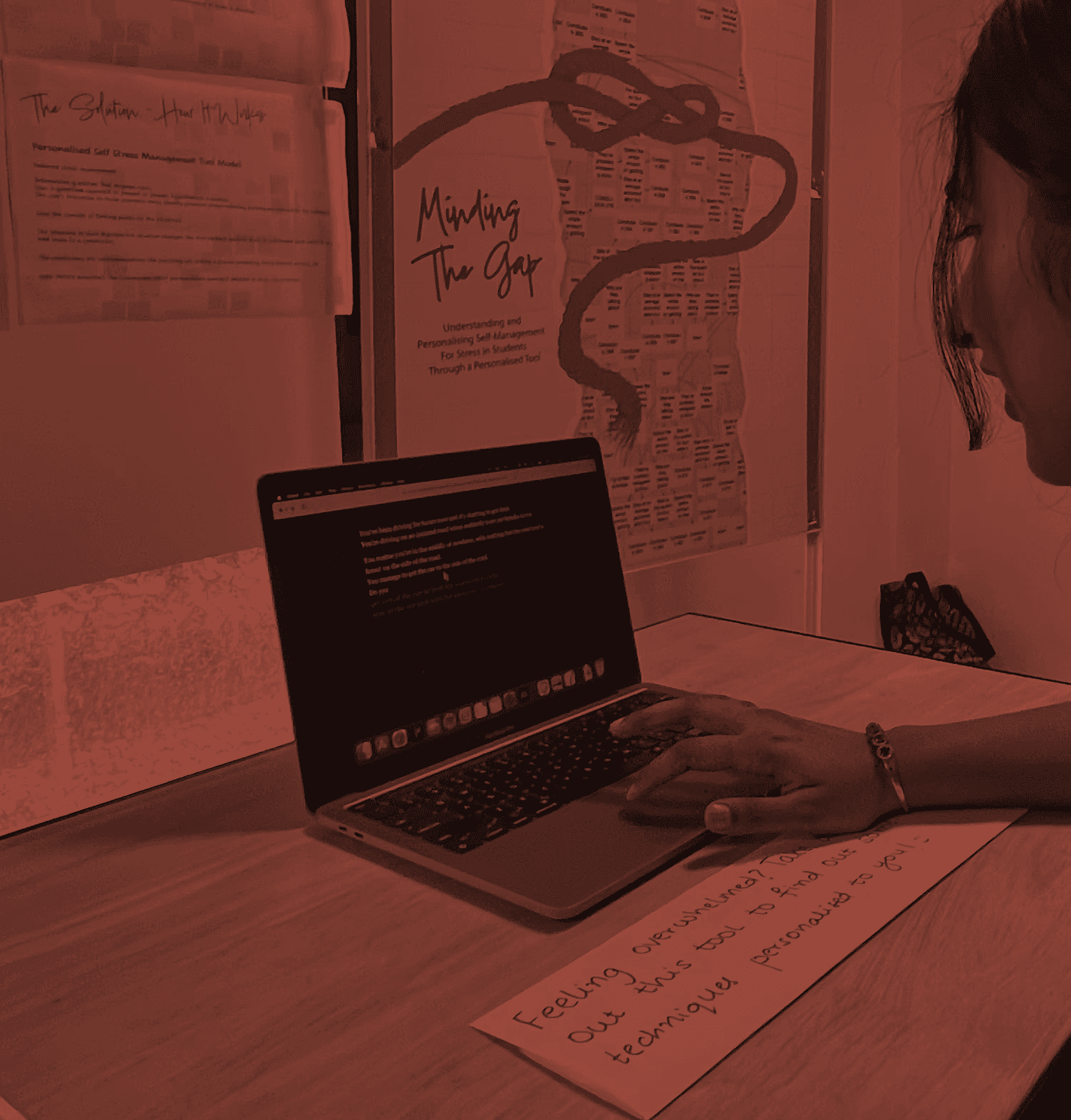

Some images from one of the many rounds of user testing
Some images from one of the many rounds of user testing
Final Note, Takeaways
Final Note, Takeaways
Final Note, Takeaways
Often with complex issues, it becomes difficult to detach and "solve" the problem. Similarly, in this case, the issue was incredibly sensitive and layered, where each person had a unique way to understand or tackle it.
This process was a journey of ups and downs. Initially felt the need to make a one-size fits all solution but after countless interviews and raw conversations, I was able to empathise and realised that an issue this complex cannot be solved in one go, just can be made better in small ways. So, this product is not a solution, it's an intervention created with the hope to actually help someone in a small way.
If I take it further, I’d also want to test the tool and refine with feedback from teachers and others educators from institutions, apart from students.
Often with complex issues, it becomes difficult to detach and "solve" the problem. Similarly, in this case, the issue was incredibly sensitive and layered, where each person had a unique way to understand or tackle it.
This process was a journey of ups and downs. Initially felt the need to make a one-size fits all solution but after countless interviews and raw conversations, I was able to empathise and realised that an issue this complex cannot be solved in one go, just can be made better in small ways. So, this product is not a solution, it's an intervention created with the hope to actually help someone in a small way.
If I take it further, I’d also want to test the tool and refine with feedback from teachers and others educators from institutions, apart from students.
Often with complex issues, it becomes difficult to detach and "solve" the problem. Similarly, in this case, the issue was incredibly sensitive and layered, where each person had a unique way to understand or tackle it.
This process was a journey of ups and downs. Initially felt the need to make a one-size fits all solution but after countless interviews and raw conversations, I was able to empathise and realised that an issue this complex cannot be solved in one go, just can be made better in small ways. So, this product is not a solution, it's an intervention created with the hope to actually help someone in a small way.
If I take it further, I’d also want to test the tool and refine with feedback from teachers and others educators from institutions, apart from students.
